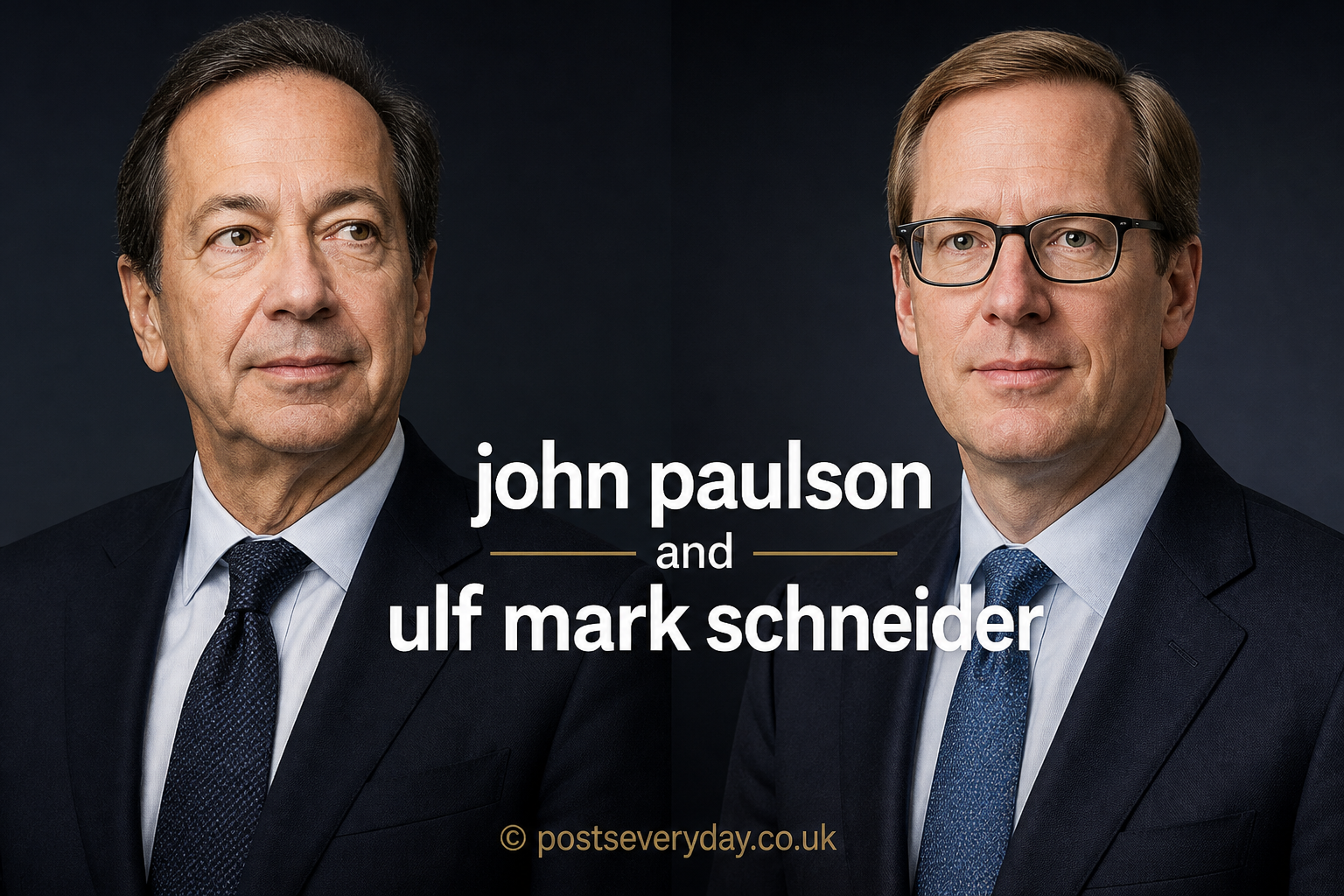
john paulson and ulf mark schneider: Two Distinct Business Careers
john paulson and ulf mark schneider: Two Distinct Business Careers
The names john paulson and ulf mark schneider often appear together in searches about influential business figures. They share an education connection and experience in international business, but their careers followed very different paths: Paulson became a prominent investor, while Schneider built his reputation as a senior corporate executive.
Why These Names Are Paired
Interest in John Paulson and Ulf Mark Schneider is understandable. Both are associated with Harvard Business School and have held influential positions in business. Yet a shared educational institution and a place in the international business landscape do not, by themselves, establish a personal or professional partnership.
The distinction matters because online searches can bring together names without explaining why. The well-documented overlap is their Harvard MBA education, completed in different years. Public biographies describe separate careers, and there is no reliable public evidence that they are relatives, close associates, or formal business partners.
A useful way to understand the pair is as a comparison between two different kinds of leadership. Paulson’s work has centred on investment decisions and financial markets. Schneider’s work has centred on managing large organisations, setting corporate priorities, and overseeing operations across countries and industries.
John Paulson’s Path in Finance
John Paulson is an American investor and the founder of Paulson & Co., an investment firm he established in 1994. Before launching it, he worked in investment banking, including mergers and acquisitions. He graduated from New York University and earned an MBA from Harvard Business School in 1980.
Paulson became widely known for investments connected to the US housing and mortgage market before the financial crisis of 2007–08. His firm took positions that benefited when mortgage-related securities lost value. The trade became one of the most discussed in modern finance, but it should not be simplified into a story of a single prediction or an effortless win: it involved research, timing, risk, and substantial uncertainty.
That episode made Paulson a familiar name well beyond Wall Street. It also illustrates the nature of hedge-fund investing: managers assess potential returns against risks, construct positions, and make decisions in markets where outcomes are not guaranteed. Public attention often focuses on a dramatic result, while the underlying work involves detailed analysis and the possibility of losses.
Paulson’s public profile has also included political and philanthropic activity. Those pursuits are distinct from his career as an investor, even though they contribute to the broader picture of a prominent business figure. Headlines about wealth or a famous trade rarely capture the full range of decisions and interests that define a long career.
Ulf Mark Schneider’s Executive Career
Ulf Mark Schneider, often publicly referred to as Mark Schneider, is a German-American business executive. He studied finance and accounting at the University of St. Gallen, earned a doctorate there, and completed an MBA at Harvard Business School in 1993. His education combined financial training with preparation for leadership in complex organisations.
Schneider began his career at the Haniel Group, holding a variety of roles, including positions connected to business development. He later became chief financial officer of Fresenius Medical Care and went on to lead the wider Fresenius Group as chief executive. His time at Fresenius gave him experience in healthcare, a sector shaped by regulation, technology, patient needs, and demanding operational responsibilities.
In 2017, Schneider became chief executive of Nestlé, the global food and beverage company. He served in the role until 2024. Leading Nestlé meant overseeing a multinational organisation with familiar consumer brands and businesses operating across varied markets. Decisions in that setting can involve investment, supply chains, product development, competition, and changing consumer expectations.
Schneider’s departure from Nestlé marked the end of his tenure as its chief executive; it did not mean his career in business ended. Current corporate biographies list him as a member of Roche’s board and Siemens’ supervisory board. These are governance roles rather than the day-to-day executive post he held at Nestlé.
Their Genuine Point of Connection
The most straightforward connection between John Paulson and Ulf Mark Schneider is that both earned MBAs from Harvard Business School. Paulson graduated in 1980, while Schneider graduated in 1993. The thirteen-year gap means they were not classmates, and the shared credential is not evidence of a friendship or joint undertaking.
Beyond education, their paths intersect in a broad sense: both worked at senior levels where finance and business strategy matter. But their responsibilities were different. An investor evaluates opportunities and risks in financial markets; a chief executive is accountable for leading an organisation, its people, and its long-term direction. Those worlds can influence one another without proving that two particular individuals worked together.
It is therefore more accurate to describe them as figures from related parts of the business ecosystem than as collaborators. Large companies rely on capital and interact with investors, while investors study companies and their prospects. That general relationship is part of modern business, not proof of a specific private or professional relationship between Paulson and Schneider.
Why the Difference Matters
Careful wording helps separate confirmed facts from speculation. The public record supports their distinct career histories, their Harvard MBA connection, and the leadership roles Schneider held at Fresenius and Nestlé. It does not support a claim that they are family members or that they jointly ran a company or investment project.
This distinction also makes the comparison more useful. Paulson’s career offers a lens on investment management, market risk, and the attention that can follow a major financial trade. Schneider’s career offers a lens on executive leadership, corporate governance, and managing multinational businesses. Comparing them can illuminate different forms of influence without inventing a personal connection.
Frequently Asked Questions
Are John Paulson and Ulf Mark Schneider business partners?
No reliable public information confirms that they are business partners. Their documented careers developed in different fields: Paulson in investment management and Schneider in corporate leadership.
Did they attend Harvard Business School at the same time?
No. Paulson earned his MBA in 1980, while Schneider earned his in 1993. They share an alma mater, but their graduation years were thirteen years apart.
Was Ulf Mark Schneider the CEO of Nestlé?
Yes. Schneider led Nestlé as chief executive from 2017 until 2024. He later held board-level roles, including positions at Roche and Siemens.
Why is John Paulson well known?
Paulson is best known to many people for investment positions connected to the US housing and mortgage market before the 2007–08 financial crisis. He founded the investment firm Paulson & Co. in 1994.
Are they related?
There is no reliable public evidence establishing a family relationship between Paulson and Schneider. Their documented connection is their shared Harvard MBA background, alongside separate careers in international business.
A Clear Takeaway
John Paulson and Ulf Mark Schneider represent two different routes to influence in business. Paulson built his public reputation through investing and financial markets; Schneider built his through senior executive work at Fresenius and Nestlé, followed by board roles. Their shared Harvard education is a genuine point of connection, but public information does not establish a direct partnership or family tie. The most accurate account of john paulson and ulf mark schneider is therefore a comparison of distinct careers, not a story of a confirmed joint venture.




Post Comment